

Hey there! As a supplier of PP Biaxial Geogrid, I often get asked if this product can be used in soft soil improvement. Well, let's dive right into it and explore the capabilities of PP Biaxial Geogrid in dealing with soft soil conditions.
First off, what exactly is soft soil? Soft soil typically refers to soil with low shear strength, high compressibility, and poor load - bearing capacity. It can cause a whole bunch of problems in construction projects. Foundations on soft soil may settle excessively, leading to cracks in buildings, damage to pavements, and other structural issues. Slopes on soft soil are also prone to instability, which can result in landslides.
Now, let's talk about PP Biaxial Geogrid. PP Plastic Biaxial Geogrid is made from polypropylene (PP) through a special biaxial stretching process. This process aligns the polymer chains in both the longitudinal and transverse directions, giving the geogrid high tensile strength in two directions. It has a grid - like structure with square or rectangular apertures.
So, can it be used in soft soil improvement? The short answer is yes, and here's why.
Mechanisms of PP Biaxial Geogrid in Soft Soil Improvement
1. Reinforcement
PP Biaxial Geogrid acts as a reinforcement material in soft soil. When it's placed in the soil, it distributes the load over a larger area. The high tensile strength of the geogrid helps to transfer the load from the weak soil to the stronger regions. Picture this: when you walk on soft soil, your feet sink in quickly because the soil can't bear your weight. But if you spread a piece of the geogrid on the soil and then walk on it, the geogrid spreads your weight out, reducing the pressure on the soil at any one point. This is similar to how it works in a construction project. The geogrid Geogrid Biaxial PP interlocks with the soil particles, preventing them from moving and deforming under load.
2. Soil Stabilization
Soft soil often has a tendency to flow and shift. The grid structure of the PP Biaxial Geogrid restricts the lateral movement of the soil particles. Soil particles get trapped within the apertures of the geogrid, creating a composite structure. This composite behaves more like a coherent mass, improving the overall stability of the soil. In slope stabilization projects, for example, the geogrid helps to hold the soil in place, reducing the risk of slope failure.
3. Improvement of Bearing Capacity
By reinforcing and stabilizing the soft soil, PP Biaxial Geogrid significantly improves the soil's bearing capacity. In a foundation construction on soft soil, the geogrid can help the soil support the weight of the building or structure above it. Instead of the soil continuously compressing and causing settlement, the geogrid - soil composite can handle the load more effectively.
Case Studies
Let's look at some real - world examples to illustrate the effectiveness of PP Biaxial Geogrid in soft soil improvement.

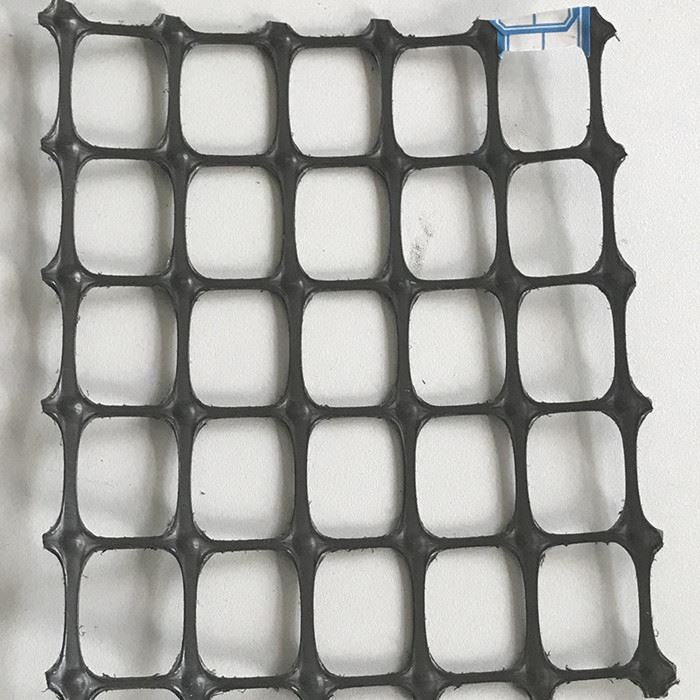
There was a road construction project in a coastal area. The soil in the area was extremely soft due to high water content and fine - grained particles. The engineers decided to use PP BX Geogrid to improve the soil conditions. They placed the geogrid at a certain depth below the road base. After the project was completed, monitoring showed that the settlement of the road was much less than expected. The road also had better resistance to rutting and cracking compared to roads built on similar soft soil without geogrid reinforcement.
Another case is a landfill project. The soft soil at the landfill site made it difficult to construct stable waste containment structures. By installing PP Biaxial Geogrid layers, the stability of the landfill slopes was improved. The geogrid helped to prevent soil erosion and the movement of waste materials, ensuring the long - term safety and functionality of the landfill.
Advantages of Using PP Biaxial Geogrid in Soft Soil
1. Cost - Effective
Compared to some traditional methods of soft soil improvement, such as soil replacement or deep foundation construction, using PP Biaxial Geogrid is often more cost - effective. It requires less material and labor, and the installation process is relatively simple.
2. Easy Installation
The geogrid can be easily unrolled and placed on the soil surface. It doesn't require complex equipment or highly skilled labor. This means that construction time can be reduced, and projects can be completed more quickly.
3. Durability
PP Biaxial Geogrid is resistant to corrosion, chemicals, and environmental factors. It can maintain its performance over a long period, providing long - term stability to the soft soil structures.
Limitations and Considerations
Of course, like any other product, PP Biaxial Geogrid also has its limitations.
1. Soil Compatibility
The effectiveness of the geogrid depends on the type of soil. In some cases, very cohesive or organic soils may not interlock well with the geogrid. It's important to conduct soil tests before using the geogrid to ensure compatibility.
2. Installation Quality
The proper installation of the geogrid is crucial. If it's not installed correctly, for example, if the overlapping of adjacent geogrid sheets is insufficient, its performance may be compromised.
In conclusion, PP Biaxial Geogrid can indeed be a great solution for soft soil improvement. It offers multiple benefits in terms of reinforcement, stabilization, and cost - effectiveness. If you're working on a project involving soft soil, it's definitely worth considering using our high - quality PP Biaxial Geogrid.
If you're interested in purchasing PP Biaxial Geogrid for your soft soil improvement projects, feel free to reach out to discuss the details. We can provide you with the right product based on your specific requirements.
References
- Das, B. M. (2014). Principles of Geotechnical Engineering. Cengage Learning.
- Madhav, M. R. (1989). Soil Mechanics: An Introduction. Wiley.
- Zornberg, J. G. (2011). Geosynthetics in Civil and Environmental Engineering. CRC Press.