

Why Choose Us?
Quality Assurance
All of our geogrid products are CE-certificate,and manufactured at ISO 9001 certified manufacturing soil reinforcement geogrids consistently meets demanding QA/QC requirements.Our Products are tested to rigorous ASTM standards both in-house.We have established a national-standard laboratory for in-house quality control. We built a strict quality control system in all aspects from raw materials testing and production processes to final product quality testing.
Professional Service
As a leading manufacturer of geosynthetics materials, we have been exported geogrid to more than 50 countries and regions abroad. On this basis, we continue to develop and provide geosynthetics products with excellent performance and professional technical services.
One-stop Geosynthetics Products
We provide one-stop geosynthetics products and solutions to global customers. Feicheng Lianyi Geosynthetics has supplied a wide range of effective and state-of-the-art Geomembranes, Geotextiles, Geocells, Geogrids to more than 50 countries and regions abroa.
Short Delivery Time
Now we own 50 sets of facilities,include 21 sets of Fiberglass Geogrid & Polyester Geogrid Production lines (include different widths of 4 meters,5meters,6meters), 9 sets of PP biaxial Geogrid Production lines (include different widths of 4 meters,5meters,6meters), 3 sets of PP & HDPE Uniaxial Geogrid Production lines, 4 sets of Steel-Plasti ccomposite Geogrid Production lines,3 sets of needlepunched Non woven geotextile & Spunbonded Nonwoven fabric ,2 Sets of Composite production lines and some production lines for Woven geotextile,HDPE Geomembrane,HDPE Geocell,Geonet etc,intotal 50 sets of machines currently,that's definitely the largest scale in China.
-
![Geosynthetic Liner HDPE Composite Geomembrane For Fishing Pond]() Geosynthetic Liner HDPE Composite Geomembrane For Fishing...Composite geomembrane is in the film on one or both sides of the oven through the far infrared heating, the geotextile and geomembrane through the guide roller together to form a compositeread more
Geosynthetic Liner HDPE Composite Geomembrane For Fishing...Composite geomembrane is in the film on one or both sides of the oven through the far infrared heating, the geotextile and geomembrane through the guide roller together to form a compositeread more -
![Geomembrane and Geotextile]()
-
![HDPE Geomembrane Composite Non Woven Geotextile]() HDPE Geomembrane Composite Non Woven Geotextilelake composite geomembrane with non woven geotextileread more
HDPE Geomembrane Composite Non Woven Geotextilelake composite geomembrane with non woven geotextileread more -
![Geotextile Composite Geomembrane for Waterproofing]() Geotextile Composite Geomembrane for WaterproofingModel NO. 200g/0.3mm/200g Product Standard GB/T17642-2008 Transport Package Woven Black Plastic Specification 400g-2500g Origin China HS Code 3920109090 Product Description Compound geomembraneread more
Geotextile Composite Geomembrane for WaterproofingModel NO. 200g/0.3mm/200g Product Standard GB/T17642-2008 Transport Package Woven Black Plastic Specification 400g-2500g Origin China HS Code 3920109090 Product Description Compound geomembraneread more -
![Nonwoven Geotextile Geomembrane]() Nonwoven Geotextile GeomembraneBasic Info Type HDPE Geomambrane Liner Roll Width 3m,4m,5m,5.8m,6m,7m,8m,13m Roll Length 50m-200m Using Life 50years Certificate Ce,SGS,ISO9001,ASTM,Gri-GM13 Product Name Geotextile Composite HDPEread more
Nonwoven Geotextile GeomembraneBasic Info Type HDPE Geomambrane Liner Roll Width 3m,4m,5m,5.8m,6m,7m,8m,13m Roll Length 50m-200m Using Life 50years Certificate Ce,SGS,ISO9001,ASTM,Gri-GM13 Product Name Geotextile Composite HDPEread more -
![Composite Geomembrane]() Composite GeomembraneBasic Info Model NO. 300g-700g Transport Package Plastic Woven Bag Packaging Specification 1m-6m Width Product Description The geomembrane is a composite of plastic film and non-woven fabric . Theread more
Composite GeomembraneBasic Info Model NO. 300g-700g Transport Package Plastic Woven Bag Packaging Specification 1m-6m Width Product Description The geomembrane is a composite of plastic film and non-woven fabric . Theread more -
![Composite Geomembrane with Nonwoven Geotextile]() Composite Geomembrane with Nonwoven GeotextileComposite Geomembrane is thermally laminated with polyethylene one or both sides of Non woven Geotextile or woven geotextile. Description of Composite Geomembrane with Nonwoven Geotextileread more
Composite Geomembrane with Nonwoven GeotextileComposite Geomembrane is thermally laminated with polyethylene one or both sides of Non woven Geotextile or woven geotextile. Description of Composite Geomembrane with Nonwoven Geotextileread more -
![Geocomposite Drainage Membrane]() Geocomposite Drainage MembraneGeocomposite drainage membrane is a kind of impervious material compounded of geotextile and geomembrane.read more
Geocomposite Drainage MembraneGeocomposite drainage membrane is a kind of impervious material compounded of geotextile and geomembrane.read more -
![Geocomposite Membrane]() Geocomposite MembraneGeocomposite Membrane has the performances of woven geotextile and nonwoven geotextile, and can be widely used in projects, such as railway, highwayread more
Geocomposite MembraneGeocomposite Membrane has the performances of woven geotextile and nonwoven geotextile, and can be widely used in projects, such as railway, highwayread more


Composite geomembrane is a kind of geosynthetic material that is combined by a variety of materials through a composite process. It usually consists of two or more layers of materials with different functions and properties to meet the requirements in engineering projects. The main purpose of the composite geomembrane is to provide anti-seepage, protection, separation, reinforcement and other functions, which can be used in water conservancy engineering, road construction, environmental engineering and other fields.
Advantages of Composite Geomembrane
Durability
Composite geomembranes are renowned for their exceptional durability. Their resistance to punctures, tears, and chemical degradation makes them ideal for use in environments that are either chemically aggressive or mechanically challenging. This robustness ensures that they maintain their integrity over long periods, even under extreme conditions such as fluctuating temperatures, UV exposure, and biological factors. This prolonged lifespan reduces the need for frequent replacements, contributing to the longevity of the projects they are used in.
Versatility
The adaptability of composite geomembranes is another key advantage. They can be tailored to meet the specific requirements of various projects, whether it’s in terms of thickness, permeability, or tensile strength. This versatility makes them suitable for a wide range of applications, from environmental protection to water management and civil engineering projects. They can be effectively used in both large-scale industrial applications and smaller, more localized projects.
Cost-Effectiveness
In terms of economic value, composite geomembranes are a cost-effective solution. Their durability translates to less frequent need for repairs or replacements, leading to reduced long-term maintenance costs. Additionally, their ease of installation reduces labor costs and minimizes the time required to complete a project, further contributing to their cost-effectiveness.
Eco-Friendly
Composite geomembranes play a significant role in promoting sustainable construction practices. By preventing contamination and efficiently managing resources like water, they contribute to environmental conservation. Their use in landfills, for instance, helps prevent soil and water pollution, while in agricultural applications, they aid in water conservation and management. By minimizing environmental impact and aiding in the conservation of natural resources, composite geomembranes align well with the goals of sustainable development.
Enhanced Safety
Safety is a paramount concern in any construction or environmental project, and composite geomembranes contribute positively in this regard. By providing reliable containment and stabilization, they reduce the risk of environmental hazards and structural failures. This aspect is particularly important in applications like hazardous waste containment, where preventing leaks and breaches is crucial for safety.
Improved Project Efficiency
Using composite geomembranes often leads to an overall improvement in project efficiency. Their ease of installation, combined with their effective performance, means that projects can be completed more swiftly and with fewer complications. This efficiency is highly beneficial in time-sensitive projects or in scenarios where minimizing disruption is important.
Application of Composite Geomembrane
Environmental Protection
In the realm of environmental conservation, composite geomembranes are a key player. They are extensively used in landfill liners to prevent hazardous waste from contaminating the soil and groundwater. This feature is crucial in maintaining ecological balance and preventing pollution of the environment. Additionally, they are employed in capping closed landfills, effectively sealing off waste materials from the surrounding environment.
Environmental Protection
The role of composite geomembranes in water management cannot be overstated. They serve as reliable liners in ponds, canals, and reservoirs, efficiently preventing water loss due to seepage and ensuring optimal water conservation. In areas prone to water scarcity, this feature is invaluable. Moreover, they are used in the construction of artificial lakes and for the lining of irrigation channels, playing a significant role in agricultural water management and conservation efforts.
Civil Engineering
In civil engineering, composite geomembranes have revolutionized traditional practices. They are used to reinforce and stabilize the foundations in road construction, effectively preventing soil erosion and ensuring the longevity of the infrastructure. This application is particularly beneficial in areas with unstable or weak soil conditions. In addition, they are also used in the construction of tunnels and underground structures for waterproofing purposes, protecting these structures from water ingress and associated damages.
Agriculture
In the agricultural sector, composite geomembranes are used in a variety of applications. They are integral in the construction of irrigation systems, where they prevent water loss and help in efficient water distribution. Furthermore, they are used in aquaculture for pond lining, ensuring water retention and quality control, which is essential for healthy aquaculture practices.
Mining Industry
In mining operations, composite geomembranes are employed in heap leach pads, where they contain the leaching solution and prevent contamination of the surrounding environment. This application is vital in minimizing the environmental impact of mining activities.
Components of Composite Geomembrane
Surface material
High-strength, corrosion-resistant polymer materials such as high-density polyethylene (HDPE) or polypropylene (PP) are usually used as the surface layer. The function of the surface layer is to provide the anti-seepage performance and protective effect of the geomembrane.
Damage-resistant layer
The damage-resistant layer is a part of the composite geomembrane, usually composed of special additives and reinforcing materials, designed to improve the aging resistance, abrasion resistance and puncture resistance of the geomembrane.
Lining material
The lining material is a layer adjacent to the surface layer, which can be polyethylene (PE), polypropylene (PP) and other materials, which are used to provide enhanced performance and tensile strength of the composite geomembrane.
Reinforcement material
The composite geomembrane may contain one or more layers of reinforcement material, such as fiber mesh, fiber cloth or polyester cloth, etc., to enhance the mechanical properties of the geomembrane and improve its tensile strength and damage resistance.
Other layers
According to specific application requirements, the composite geomembrane may also contain other layers of materials, such as anti-skid layer, waterproof layer, filter layer, etc. These layers of materials can provide additional functions and properties.
Installation Tips For Composite Geomembranes
Preparation Of The Subgrade
The subgrade, or the surface on which the geomembrane will be laid, should be properly prepared. This involves grading, compacting, and smoothing the area to remove any objects or irregularities that might damage the geomembrane. Such as tree roots, stones, etc.
Correct Placement
Proper alignment of the geotextile and geomembrane layers is critical for the overall effectiveness of the composite geomembrane. This involves ensuring that there are no wrinkles or folds, which can create weak points and reduce the material’s effectiveness. The surface on which the geomembrane will be laid should be smooth and free from sharp objects that could puncture the material.
Proper Sealing
The impermeability of composite geomembranes largely depends on the quality of the seams. It’s essential to use the right sealing techniques, such as thermal or chemical welding, to ensure that the seams are watertight and secure. Pay special attention to areas around corners and edges, as these are often the most vulnerable to leaks. Regular testing of seam integrity, such as peel and shear tests, can help verify the quality of the seal.
Anchoring And Protection
Once laid, the geomembrane should be anchored securely to prevent displacement. In some cases, a protective layer, like a geotextile or a layer of soil, may be added on top of the geomembrane to protect it from mechanical damage, UV exposure, and other environmental factors.
Professional Help
For complex or large-scale projects, it's advisable to engage with professionals who specialize in geomembrane installation. Their expertise can help avoid common installation mistakes and ensure that the geomembrane is installed to the highest standard. This is especially important in projects that require strict compliance with environmental regulations.
Quality Control
Throughout the installation process, maintain strict quality control practices. This includes inspecting the materials for defects before installation, monitoring the installation process closely, and conducting post-installation inspections to ensure that the geomembrane is performing as expected.
Training And Supervision
Ensure that the personnel involved in the installation are adequately trained and supervised. Proper handling and installation techniques are crucial to the success of the geomembrane application.
- The use must be embedded: The thickness of the cover should not be less than 30cm.
- The renovation anti-seepage system should consist of: a cushion layer, anti-seepage layer, transition layer, and protective layer.
- The soil body should be solid, to avoid uneven subsidence, cracks, and the turf and tree roots within the anti-seepage range should be removed. Sand or clay with small particle size is laid on the contact surface with the membrane as a protective layer.
- When laying, the geomembrane should not be pulled too. It is better to embed the soil at both ends into a corrugated shape, especially when it is anchored with rigid materials, there should be a certain amount of expansion and contraction.
- During construction, stones should be avoided, and heavy objects should be smashed on the geomembrane. It is best to lay the membrane and cover the protective layer during construction.

Hot Wedge Welding
This method involves using a hot wedge to melt the geomembrane material along the seam to be welded. The two composite geomembrane sheets are placed edge to edge, and the hot wedge is pressed against them, melting the material and creating a strong bond as it cools. Hot wedge welding is commonly used for welding HDPE and other thermoplastic geomembranes.
Hot Air Welding
Hot air welding uses a handheld or automated hot air gun to heat the composite geomembrane material along the seam. Once the material reaches the appropriate temperature, the two geomembrane sheets are pressed together, allowing them to fuse as the material cools. Hot air welding is suitable for a variety of geomembrane materials, including PVC and HDPE.
Extrusion Welding
Extrusion welding involves feeding a rod or bead of molten composite geomembrane material into a heated extrusion gun. The gun melts the material and applies it directly to the seam between the two geomembrane sheets, creating a strong, continuous bond. Extrusion welding is particularly useful for welding thick geomembranes and for making repairs.
Electrofusion Welding
Electrofusion welding utilizes an electric current to heat specialized fittings that are embedded with a heating element. The fittings are attached to the ends of the geomembrane sheets to be joined. When the current is applied, the heating element melts the geomembrane material, allowing the sheets to fuse together. Electrofusion welding is commonly used for joining HDPE geomembranes in large-scale applications.
Chemical Welding
Chemical welding involves using solvents or adhesives to chemically bond composite geomembrane sheets together. The solvent is applied to the seam between the sheets, causing the material to soften and fuse as the solvent evaporates. Chemical welding is suitable for certain types of geomembranes, such as PVC and CSPE.
What Are the Composite Geomembrane Production Processes?
Material Selection
Composite Geomembranes are commonly made from polymers such as high-density polyethylene (HDPE), low-density polyethylene (LDPE), polyvinyl chloride (PVC), ethylene propylene diene monomer (EPDM), or chlorosulfonated polyethylene (CSPE). The selection of the polymer depends on factors like chemical resistance, flexibility, and UV stability.
Extrusion
The most common method for producing composite Geomembranes is the extrusion process. In extrusion, polymer resin pellets are melted and forced through a die to form a continuous sheet of the desired thickness and width. The thickness of the composite Geomembrane can be controlled by adjusting the speed of the extrusion process and the design of the die.
Calendering
In some cases, after extrusion, the composite Geomembrane may undergo a calendering process. Calendering involves passing the extruded sheet between heated rollers to further smooth and flatten the surface, as well as to adjust the thickness of the composite Geomembrane.
Texturing
Depending on the application, composite Geomembranes may be textured to improve their interface friction characteristics. Texturing can be achieved during the extrusion process by using a textured die or by embossing the surface of the composite Geomembrane after extrusion.
Quality Control
Throughout the production process, quality control measures are implemented to ensure that the composite Geomembranes meet the required specifications for strength, thickness, flexibility, and other properties. This may involve testing samples of the composite Geomembrane for tensile strength, tear resistance, puncture resistance, and chemical resistance.
Rolling and Packaging
Once the composite Geomembrane has been manufactured and passed quality control tests, it is typically rolled onto large spools or rolls for transportation and storage. The rolls may be packaged and labeled according to size, thickness, and other specifications.
What Are the Properties of Composite Geomembrane?
Strength and Durability
Composite geomembranes exhibit high tensile strength and tear resistance to withstand loads and stresses during installation and throughout their service life. They are designed to maintain their integrity under various environmental conditions, including exposure to chemicals, UV radiation, and temperature fluctuations.
Flexibility
Composite geomembranes are flexible and can conform to irregular surfaces and contours, making them suitable for lining applications in ponds, landfills, reservoirs, and other structures with complex geometries.
Chemical Resistance
Composite geomembranes are resistant to a wide range of chemicals, including acids, bases, solvents, and hydrocarbons. This property is crucial for applications involving containment of hazardous waste, industrial effluents, and other potentially harmful substances.
Impermeability
Composite geomembranes provide an impermeable barrier to fluids and gases, preventing the migration of contaminants into the surrounding environment or groundwater. They are used to line landfills, ponds, lagoons, and other containment facilities to prevent leakage and pollution.
UV Resistance
Some composite Geomembranes are formulated with additives or coatings to enhance their resistance to UV radiation and prolong their service life in outdoor applications.
Seam Strength
Composite geomembranes can be fabricated in large panels and seamed together using various welding or adhesive techniques. The strength and integrity of the seams are critical for maintaining the overall effectiveness of the composite Geomembrane liner.
Temperature Resistance
Composite geomembranes can withstand a wide range of temperatures, from freezing conditions to high temperatures encountered in hot climates or industrial processes.
How Does Composite Geomembrane Adjust Soil Properties?
Permeability adjustment
The waterproof properties of the composite geomembrane can effectively reduce the penetration of water, thereby adjusting the permeability of the soil. This has an impact on controlling the moisture level of the soil, slowing down the water infiltration rate, and changing the moisture distribution of the soil.
Enhanced stability
The composite geomembrane forms a stable layer in the soil, which can improve the shear strength and overall stability of the soil. This plays an important role in enhancing the soil’s bearing capacity and reducing deformation.
Isolation effect
Composite geomembrane can isolate moisture, chemicals and other harmful substances between different soil layers. By isolating, soil components do not mix easily, helping to maintain soil uniformity.
Prevent soil erosion
In soil and water conservation projects, the use of composite geomembranes can effectively prevent soil erosion from water flow. It forms a waterproof layer that protects the soil surface from erosion by rain or water flow and maintains soil stability.
Adjust soil moisture
By slowing water penetration, composite geomembranes help adjust soil moisture. This has important application value for some engineering projects that require soil moisture control, such as gardening, agriculture, and landscape design.
Proper Installation
Properly install composite geomembranes according to the guidelines provided by the manufacturer and the recommendations of professionals. Make sure the surface is clean, flat, and avoid direct contact with the composite geomembrane with sharp objects or sharp edges to reduce the risk of damage.
Quality Control
Use composite geomembrane products that meet specifications and quality standards to ensure reliable quality. Low-quality or substandard materials can cause faster aging and damage.
Regular Inspections and Maintenance
Regularly inspect composite geomembranes to look for damage, punctures, or damage and repair them promptly. Regular maintenance can help prevent potential problems from getting worse.
Avoid UV Exposure
Composite geomembranes may be sensitive to UV rays, and prolonged exposure to sunlight may accelerate aging. Using sun protection or adding a UV stabilizer can help extend its life.
Prevent chemical damage
Avoid contact of the composite geomembrane with chemical substances (such as acids, alkalis, solvents, etc.) as these substances may cause the degradation of the composite geomembrane.
Avoid sharp objects and mechanical damage
Avoid direct contact of sharp objects with the surface of the composite geomembrane, use a protective layer or take precautions to prevent mechanical damage.
Reasonable use
Use composite geomembrane according to design requirements and recommendations, and do not exceed its load-bearing capacity and designed use range.
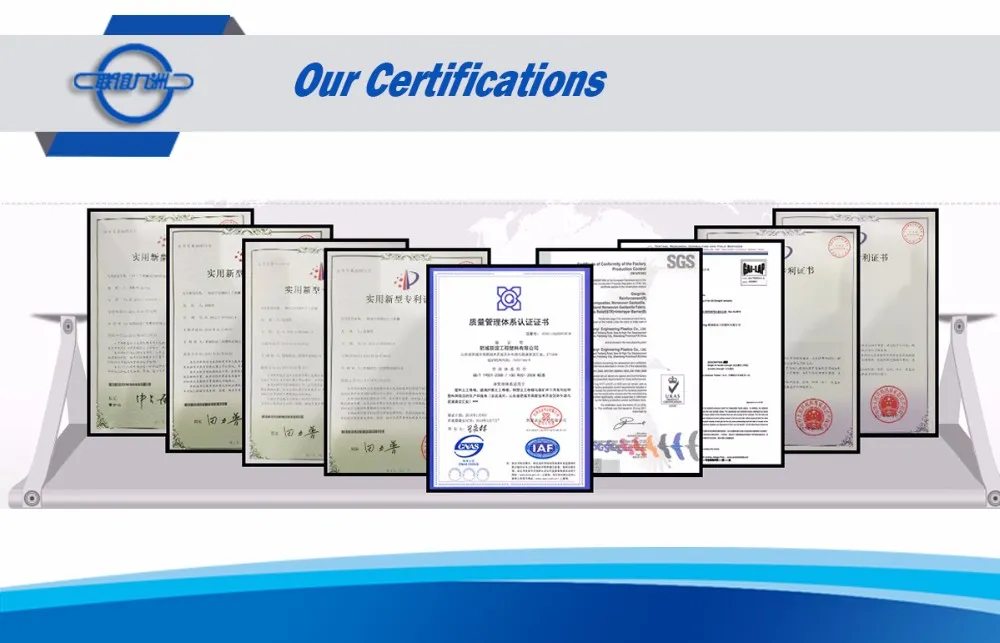
Our Certifications
ISO 9001 ,CE certificate and GB/T24001/ISO14001,GB/T24001/ISO14001
Our Factory
Feicheng Lianyi Engineering Plastics Co., Ltd has an excellent team with strong professional and technical capabilities, strong scientific management capabilities, and strong market development capabilities, talents who are good at operation and management, and a young, professional, energetic, pioneering and enterprising team. Enterprises bring infinite vitality. We attaches great importance to product promotion and brand building, and has established a wide range of win-win cooperation relationships.
Ultimate FAQ Guide to Composite Geogrid
We're known as one of the most professional composite geomembrane manufacturers and suppliers in China, featured by quality products and good service. Please feel free to buy composite geomembrane at competitive price from our factory.
Geocomposite Drainage Membrane, Geocomposite Membrane, Composite Geomembrane With Nonwoven Geotextile