

As a supplier of nonwoven geotextile, I often encounter inquiries about various technical parameters of our products. One of the most frequently asked questions is about the elongation at break of nonwoven geotextile. In this blog post, I will delve into what elongation at break means, its significance in nonwoven geotextile applications, and how it relates to our specific product offerings.
Understanding Elongation at Break
Elongation at break is a crucial mechanical property that measures the maximum amount of stretching a material can undergo before it breaks. It is typically expressed as a percentage of the original length of the specimen. For nonwoven geotextiles, this parameter indicates how much the fabric can deform under tension before failure.
To determine the elongation at break, a standard test method is employed. A sample of the nonwoven geotextile is cut into a specific shape and size, usually a rectangular strip. The sample is then clamped at both ends in a tensile testing machine. The machine gradually applies a pulling force to the sample until it breaks. During the test, the machine records the change in length of the sample as the force increases. The elongation at break is calculated by dividing the increase in length at the point of breakage by the original length of the sample and multiplying by 100.
Significance of Elongation at Break in Nonwoven Geotextile Applications
The elongation at break of nonwoven geotextile plays a vital role in its performance in various applications. Here are some key areas where this property is of great importance:
Soil Stabilization
In soil stabilization projects, nonwoven geotextiles are used to reinforce the soil and prevent erosion. When the geotextile is placed in the soil, it is subjected to various forces, such as the weight of the soil, traffic loads, and natural movements of the ground. A high elongation at break allows the geotextile to stretch and conform to the shape of the soil without breaking. This ensures that the geotextile can effectively distribute the forces acting on the soil and maintain its stability.
Drainage
Nonwoven geotextiles are also commonly used in drainage systems. They act as filters, allowing water to pass through while preventing the passage of soil particles. In drainage applications, the geotextile may be subjected to stretching forces due to the movement of water and the settlement of the surrounding soil. A geotextile with a sufficient elongation at break can withstand these forces without tearing, ensuring the long - term effectiveness of the drainage system.
Road Construction
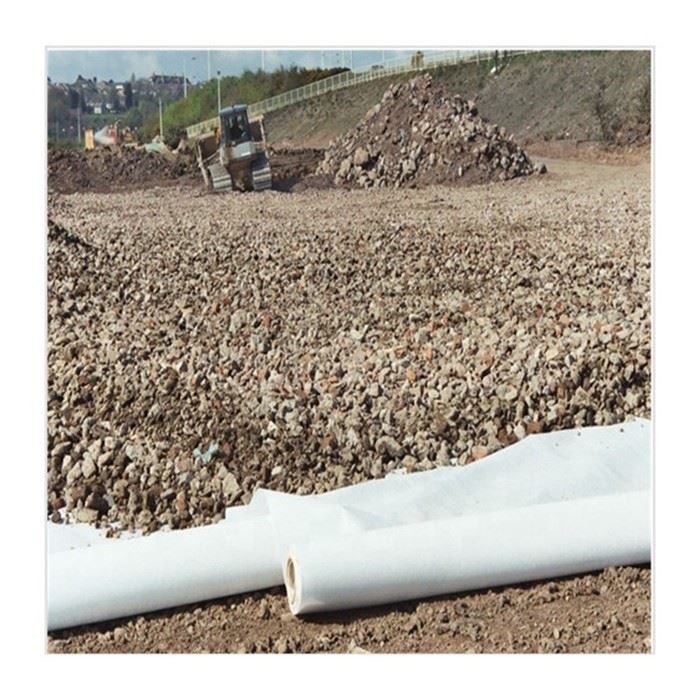
In road construction, nonwoven geotextiles are used as a separation layer between the subgrade and the base course. They prevent the mixing of different soil layers and improve the overall performance of the road. During the construction process, the geotextile may be stretched when it is laid over uneven terrain or when heavy construction equipment passes over it. A high elongation at break enables the geotextile to withstand these stresses and maintain its integrity, providing a stable foundation for the road.
Elongation at Break of Our Nonwoven Geotextile Products
At our company, we offer a wide range of nonwoven geotextile products with different elongation at break values to meet the diverse needs of our customers.
Our Long Silk PET Nonwoven Geotextile Fabric is made from high - quality polyester fibers. It has excellent mechanical properties, including a relatively high elongation at break. This makes it suitable for applications where the geotextile needs to withstand significant stretching forces, such as in large - scale soil stabilization projects and heavy - traffic road construction.
The Geotextile Fabric For Driveway we provide is designed specifically for driveway construction. It has an optimal elongation at break that allows it to adapt to the movements of the underlying soil and the weight of vehicles. This ensures that the geotextile can effectively separate the subgrade and the base course, preventing the formation of potholes and other road defects.
Our Non Woven Polyester Fiber is another product with good elongation at break characteristics. It can be used in a variety of applications, including drainage, erosion control, and landscaping. The high elongation at break of this product ensures its durability and long - term performance in different environmental conditions.
Factors Affecting the Elongation at Break of Nonwoven Geotextile
Several factors can influence the elongation at break of nonwoven geotextile. These include:
Fiber Type
Different types of fibers have different mechanical properties. Polyester fibers, for example, generally have good strength and elongation characteristics. Polypropylene fibers may have different elongation at break values depending on their molecular structure and processing methods.
Fiber Orientation
The orientation of the fibers in the nonwoven geotextile can affect its elongation at break. In a nonwoven fabric, the fibers can be randomly oriented or have a certain degree of alignment. A more randomly oriented fiber structure may result in more uniform elongation properties in different directions, while a more aligned fiber structure may lead to higher elongation in the direction of fiber alignment.
Manufacturing Process
The manufacturing process of nonwoven geotextile can also impact its elongation at break. Processes such as needle - punching, thermal - bonding, and chemical - bonding can affect the way the fibers are held together and the overall structure of the fabric. Needle - punched nonwoven geotextiles may have different elongation properties compared to thermally - bonded ones.
Quality Control and Testing
To ensure that our nonwoven geotextile products meet the required elongation at break standards, we implement strict quality control measures. Our production facilities are equipped with advanced testing equipment, and our quality control team conducts regular tests on samples from each production batch.
We follow international standards and testing methods, such as ASTM (American Society for Testing and Materials) and ISO (International Organization for Standardization) standards, to ensure the accuracy and reliability of our test results. By maintaining high - quality control, we can guarantee that our customers receive nonwoven geotextile products with consistent and reliable elongation at break values.
Conclusion
The elongation at break of nonwoven geotextile is a critical property that affects its performance in various applications. As a nonwoven geotextile supplier, we understand the importance of this parameter and strive to provide our customers with products that meet their specific requirements. Our range of products, including Long Silk PET Nonwoven Geotextile Fabric, Geotextile Fabric For Driveway, and Non Woven Polyester Fiber, offer different elongation at break values to suit different applications.
If you are interested in learning more about our nonwoven geotextile products or have specific requirements regarding elongation at break, please feel free to contact us. Our team of experts is ready to assist you in selecting the most suitable product for your project and providing you with detailed technical information. We look forward to the opportunity to work with you and contribute to the success of your projects.

References
- ASTM D4595 - Standard Test Method for Tensile Properties of Geotextiles by the Wide - Width Strip Method.
- ISO 10319:2019 - Geosynthetics — Determination of tensile properties of geotextiles and geotextile - related products.